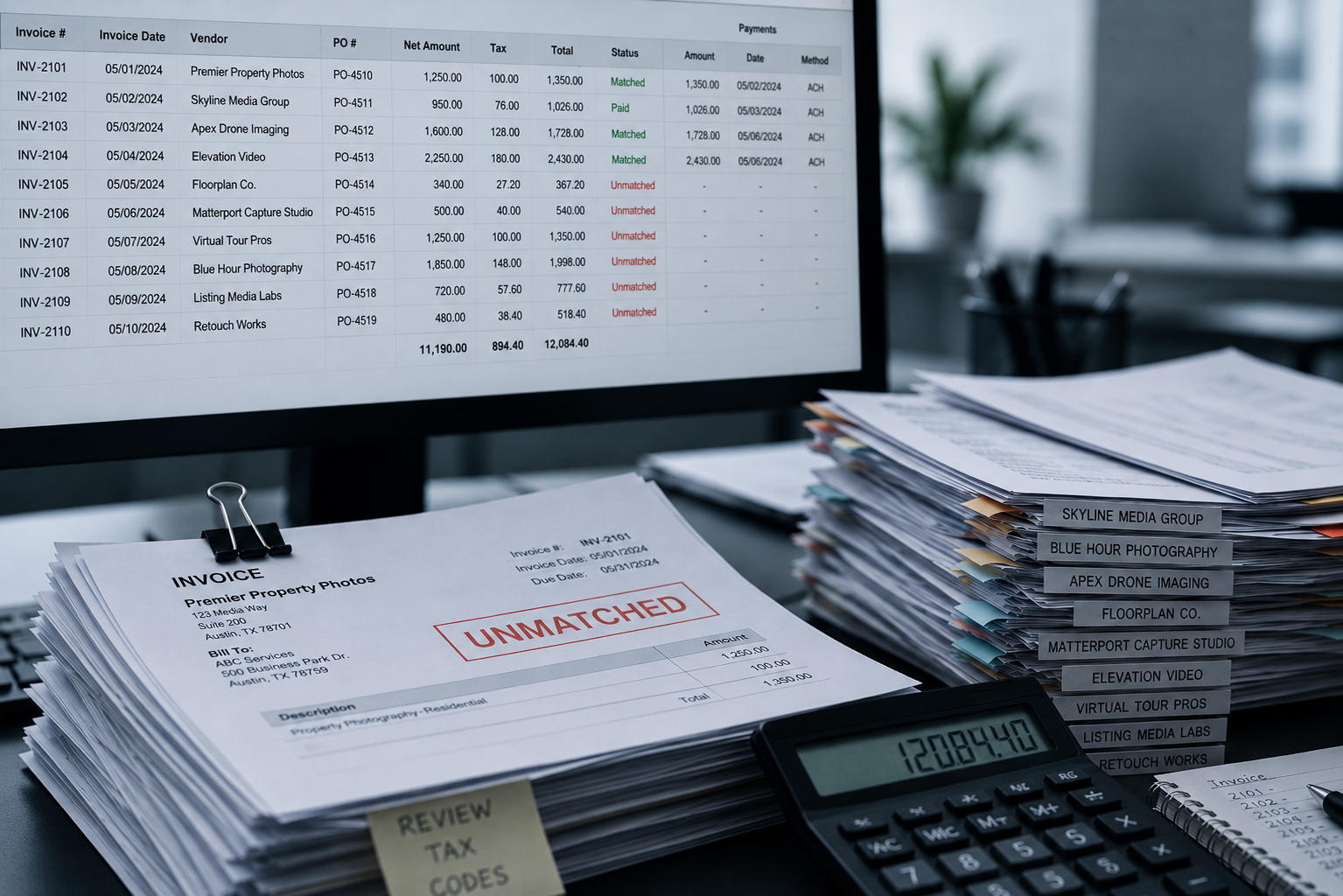
Most enterprise brokerages think they have a media spend problem. They do not. They have a reconciliation problem. The labor is not in procurement. It is in accounts payable. And because it lives in AP, it almost never makes it to the operations review where it could be solved.
This audit is the framework we run with finance leadership at every enterprise discovery call. It surfaces the reconciliation tax in dollar terms, in head-count terms, and in opportunity-cost terms. By the end of the exercise the same number sits on three sides of the table.
Anatomy of the reconciliation tax
Five vendors per office, forty offices, 25,000 listings a year. That is a baseline enterprise residential brokerage in the US. Each vendor invoices on its own cadence: some monthly, some weekly, some per-listing. Accounts payable receives somewhere between 1,200 and 2,400 distinct invoices annually. Each one has to be matched, coded, and approved. Three steps. Each one is its own tax.
Step one: matching
Match the invoice to the listing it covers. Some vendors attach the listing address. Some attach the agent name. Some attach a job number that nobody at the brokerage recognizes. Some attach nothing. The matching pass is ten to twenty minutes per invoice on average, longer when the vendor uses a legal entity name that differs from the trade name in the spreadsheet.
Step two: coding
Once matched, the invoice gets coded to the right cost center. Office. Region. Property type. Marketing budget vs operations. Brokerage-paid vs agent-reimbursed. A 25,000-listing firm has somewhere between forty and ninety active cost-center tags. AP gets a fraction of those wrong in any given month, and the misallocations surface during quarterly reviews when the wrong office is over budget for reasons nobody can quickly trace.
Step three: approval routing
The invoice routes through an approval chain. Office manager, regional ops lead, finance approver. Some chains are documented; many are tribal. Approvals get stuck on people who are traveling, out, or have moved roles. AP chases. The invoice ages. Late-pay penalties accrue. Vendor relationships get nicked at exactly the moment the brokerage is trying to deepen them.
Finance teams on a 40-office brokerage spend six to twelve hours per office per month reconciling media invoices. That is 2,880 to 5,760 hours a year on a task that produces zero strategic value, and it scales with the portfolio.
The costs you actually pay
The visible cost is the loaded finance labor: a $95-per-hour AP analyst working 2,880 to 5,760 hours a year on reconciliation is $275,000 to $550,000 of direct cost. That is the conservative number. Four other costs ride alongside it.
- Late-pay penalties. Invoices stuck in approval chains age past terms. Net 30 stretches to net 50. Some vendors add 1 to 2 percent late fees; others just delay future bookings. Both costs are real and unbudgeted.
- Cost-center misallocation. When the matching is rushed, invoices get coded to whichever cost center looks closest. Quarterly variance reviews then chase phantom overruns, and the corrective re-coding is a second pass of the same labor.
- Procurement opportunity cost. The AP team is the right team to run vendor-spend analytics. They are too busy reconciling invoices to produce them. The brokerage loses the pricing-leverage program that the same team could be running.
- Audit risk. Misallocated cost-center coding compounds across years. A clean audit becomes a forensic rebuild of the prior fiscal year, often during the worst possible quarter for finance attention.
What replaces the per-vendor invoice stack
The fix is not faster matching. The fix is collapsing the thousands of invoices into a single consolidated invoice per cadence, with the matching and coding done upstream of AP, inside the booking workflow itself.
One: consolidated invoicing
One invoice per cadence (weekly, biweekly, monthly, whatever the finance team prefers) covering every booking across the entire portfolio. Line items per booking, with the listing address, service spec, vendor name, delivery timestamp, and cost-center tag attached. AP receives one document instead of 100 to 200.
Two: cost-center tags at the booking
The cost-center allocation happens when the booking is created in the platform, not when the invoice arrives at AP. The office manager who creates the booking knows the office and the listing. The platform routes the cost center automatically. Misallocations drop from the AP error rate to the booking error rate, which is much lower because the person creating the booking has the context.
Three: standard exports into AP and GL
The consolidated invoice exports into the AP and GL systems enterprise brokerages already use. NetSuite, Sage Intacct, Workday, Yardi. AP reconciles against the operating budget in the system they live in. The platform is invisible to them, which is the right outcome.
What the savings actually look like
On a 40-office firm, the consolidated-invoicing model takes the reconciliation labor from 2,880 to 5,760 hours a year down to approximately 240 to 480 hours, depending on portfolio complexity. That is the labor required to review and approve the single consolidated invoice, audit the cost-center allocations on exception, and produce the finance reports the platform now feeds directly.
The right question is not how much the platform costs. The right question is how much the AP team can do with the 2,400 to 5,000 hours a year the platform gives them back.
That returned capacity is where the second-order value compounds. The vendor-spend analytics program, the pricing leverage exercise, the audit-readiness program, the cost-of-fragmentation work covered in our earlier piece all get run by the same AP team, with the same headcount, on the time the consolidated-invoicing model returned.
How to run the audit in your finance team
Three numbers produce a defensible reconciliation-tax figure for any enterprise brokerage. Have the AP lead pull them.
- Average distinct vendor invoices processed per month, across the last twelve months.
- Average loaded labor minutes per invoice, from receipt to approved-to-pay status.
- Annual late-pay penalty and cost-center re-coding expense, pulled from the GL.
Multiplied out, the three numbers produce the reconciliation-tax figure. We typically run this exercise in the first ninety minutes of an enterprise discovery call. The framework is referenced in the about page and the implementation phases are listed on the enterprise FAQ.