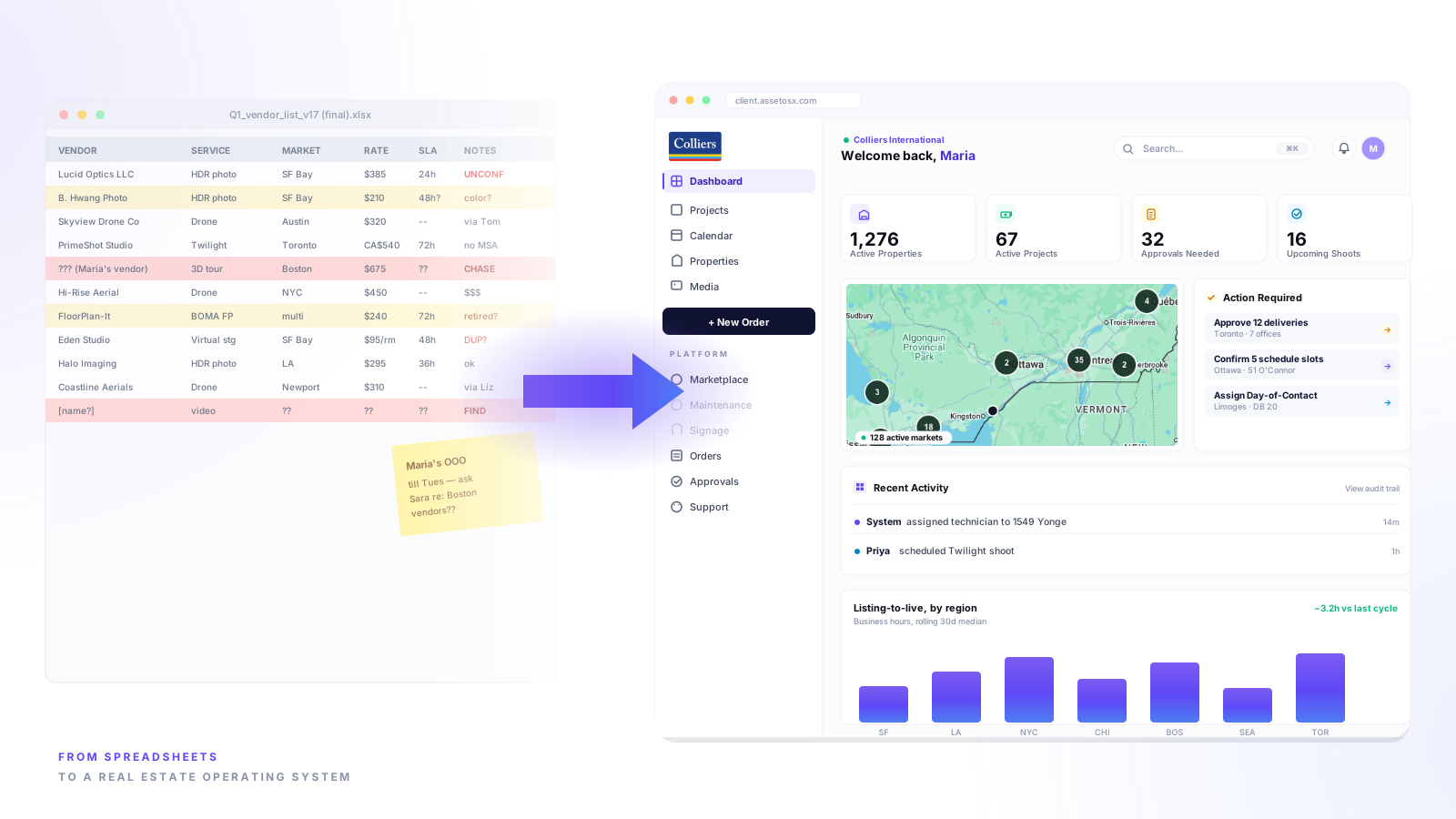
Every enterprise brokerage runs a vendor spreadsheet at some point. It starts as a single tab with five photographers in one market. Over time it grows tabs for video, drone, 3D, florists, signage installers, and stagers. By year three it has thirty tabs, six color codes that nobody documents, and a single marketing coordinator who is the only person who knows what the orange rows mean. That spreadsheet is not the problem. The problem is that an entire enterprise operation runs on top of it.
This is the transition arc we have walked through with dozens of multi-office brokerages, landlords, and portfolio managers moving from spreadsheet-led media operations to a platform model. The milestones are predictable. The failure modes are predictable. The pace is mostly a function of how willing the organization is to enforce the new standard while the old one is still warm.
Why the spreadsheet stops working
The spreadsheet is not bad. For one office or a single market, it is the right tool. It captures contacts, rates, notes about who handles what well, and a rough sense of vendor reliability. The spreadsheet breaks for four reasons, all of them structural, none of them solvable with a better spreadsheet.
It cannot enforce a spec
A spreadsheet records intent. It does not block a non-compliant delivery from reaching marketing or the listing platform. Compliance becomes the inbox of whoever owns the file, and that person has a day job.
It cannot route work
When a shoot needs to be booked, the spreadsheet does not know which vendor is available, which has the highest performance score, or which has been coached three times this quarter. Routing decisions land back on the office, which defaults to the relationship rather than the optimal match.
It cannot reconcile
Every vendor still invoices on its own template. The spreadsheet does not produce a consolidated invoice or a traceable line item per listing. Finance reconciliation lives downstream of the spreadsheet entirely.
It is one person deep
The most reliable predictor of an operations program reverting is the marketing coordinator going on leave for two weeks. When the program survives that test, it is no longer a spreadsheet program. When it does not, the spreadsheet was the program.
The spreadsheet was never the operating system. A person was. The transition to a platform is not about software replacing the spreadsheet. It is about the operating system surviving without that one person at the center.
The five milestones of the transition
We map every enterprise transition against the same five milestones. Each one is a binary: either the milestone is in place across the rolled-out region, or it is not. Treating these as percentages produces a program that is partially live and fully shadow-systemed at the same time.
Milestone 1: every service has a spec
Photography, video, 3D, floor plans, signage. One page per service, written by an operator, reviewed by marketing, approved by the brand owner. Without specs, the rest of the program is decoration. This is the milestone most programs try to skip; it is also the one that determines whether year two looks like year one or whether the program actually scales.
Milestone 2: pricing is published per market
Not one national price. One published price per service per market, with a defensible rationale. The moment pricing is visible without a quote cycle, self-serve booking unlocks and procurement stops being the bottleneck between the listing agent and the asset.
Milestone 3: bookings happen in the platform
Not in email threads. Not in a Slack channel. Not on the back of the spreadsheet. The booking is a structured record with a listing, a service spec, a date, a vendor assignment, and an SLA window. Until bookings are in the platform, nothing downstream (routing, scoring, invoicing) can run.
Milestone 4: assets live in one library
Every shoot, every deliverable, every revision, with metadata for listing address, property type, vendor, spec version, and status. The library is the system of record. Until it is, the marketing team still has a shadow Dropbox somewhere, and the platform is one of several archives instead of the authoritative one.
Milestone 5: invoicing is consolidated
One invoice per cadence with per-office, per-region, and per-cost-center breakouts. Per-line traceability back to the booking, the vendor, and the delivery timestamp. Finance teams reconcile against operating budgets instead of matching PDFs to PO numbers. This milestone is the one finance teams will evangelize for you.
The thing that breaks the transition
Every transition we have watched fail has failed for the same reason: the program rolled out the platform without decommissioning the spreadsheet. Both ran in parallel. The offices used whichever was easier on the day. The platform looked underadopted. Leadership concluded the platform was the problem and pulled back. The spreadsheet survived.
Parallel running is not a soft transition. It is a guaranteed failure mode. The platform replaces the spreadsheet on day one in the rolled-out market, or the spreadsheet replaces the platform inside a quarter.
The fix is sequencing. Roll out one market at a time. In each market, the day the platform goes live is the day the spreadsheet is archived (not deleted, but read-only) and the booking flow is platform-only. Office managers and marketing coordinators get training, a hotline, and an explicit two-week adoption support window. After two weeks the spreadsheet stays read-only and the platform is the single source of truth.
What good looks like at twelve months
A clean transition produces five observable outcomes inside twelve months. We measure these at every quarterly review on every enterprise account.
- The marketing coordinator can take a two-week vacation without the program degrading.
- Finance produces a portfolio media spend report in under an hour, sliced by office, region, and cost center.
- New offices joining the rollout reach steady-state booking volume inside ten business days.
- Vendor performance scores are reviewed quarterly, with a documented rotation of the bottom and top performers.
- Marketing retrieves a closed-listing asset bundle in under two minutes, eighteen months after closing.
The platform layer is not the product
Every step in this transition is doable on a spreadsheet, with enough heroics from a small team. The platform layer is not the value proposition. The specs, the published pricing, the SLAs, the asset library, the consolidated invoicing are the value proposition. The platform is the thing that keeps them enforced at month twelve when the marketing coordinator is on leave and the program has expanded into eight new markets.
That is the model AssetOSX runs for multi-office brokerages, landlords, and portfolio managers across the US and Canada. The implementation framework, the vetted vendor network, and the published commercial models are detailed on the about page and the enterprise FAQ.