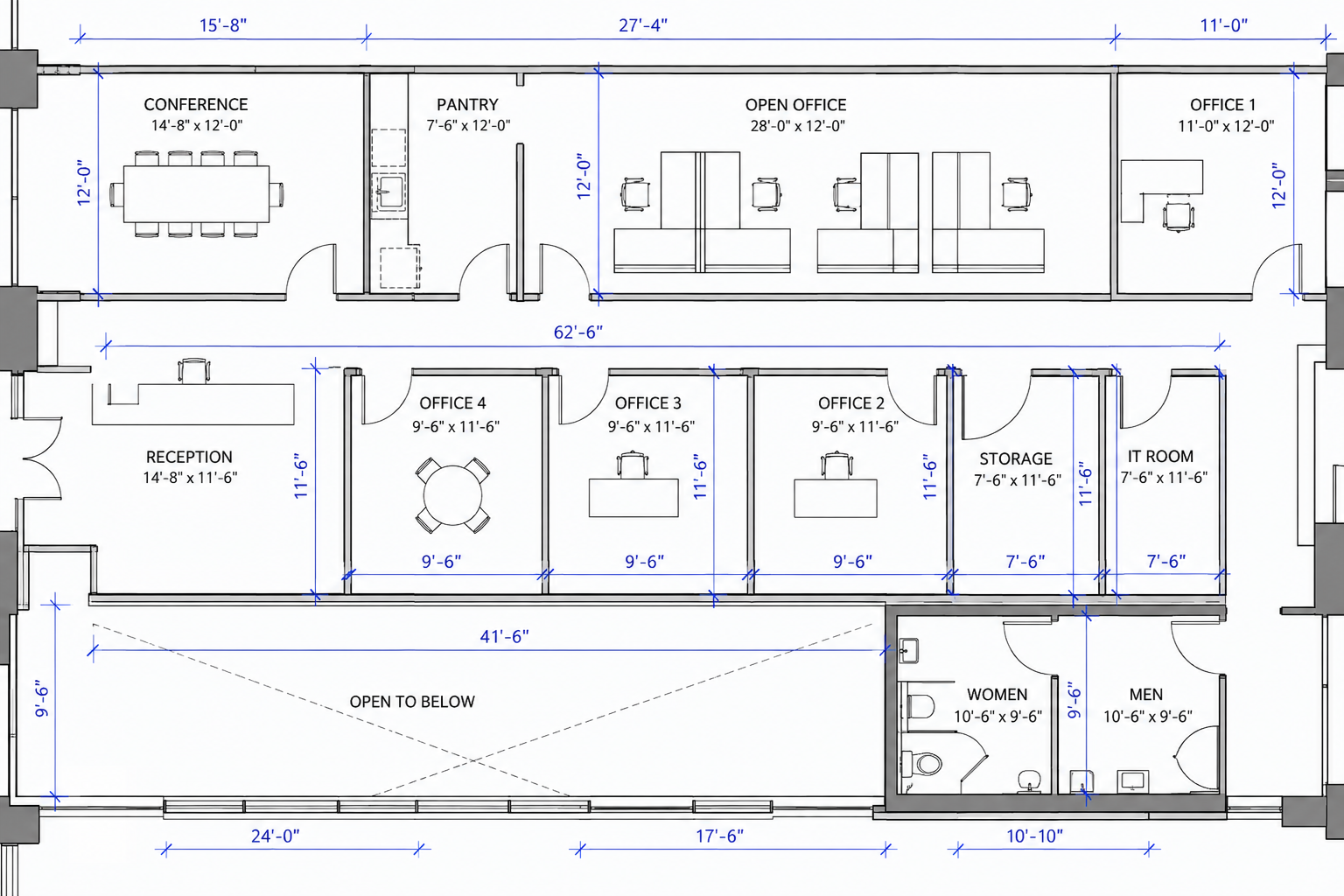
BOMA-compliant floor plans look like a procurement detail. They are not. The numbers on a BOMA drawing show up directly in every lease, every load factor, every tenant reconciliation, and every disposition pro forma. Get them wrong and the cost compounds through every dollar of rent the building collects.
Most enterprise CRE teams treat floor plan measurement as a line item the architect handles. That works on a single asset. Across a portfolio of fifty to several hundred properties, treating BOMA as an afterthought is how brokerages end up with three different load factors on three nearly-identical office buildings, leases negotiated against inconsistent rentable areas, and tenant disputes that drag for quarters.
What BOMA actually governs
BOMA International publishes the floor area measurement standards used across commercial real estate in North America. The standards do two things. They define what counts as usable area, rentable area, and common area for each asset class. And they define how those areas roll up into the load factor that converts usable space to rentable space on a lease.
The standard that applies depends on the building type. Office runs BOMA 2017. Industrial runs BOMA 2019. Multi-family residential runs BOMA Residential 2010. Retail runs BOMA Retail 2010. Mixed-use buildings stack multiple standards depending on which floors house which uses. The wrong standard on a delivered floor plan is not a stylistic preference; it is a defect that gets caught at the lease desk or, worse, after the lease is signed.
The three numbers that matter
Every BOMA deliverable reduces to three numbers per floor: usable area, rentable area, and common-area factor (sometimes called load factor or R/U ratio). Everything else is supporting work.
Usable area
The square footage a tenant can physically occupy and use, measured from the inside face of permanent walls. Excludes vertical penetrations (elevator shafts, stair cores, mechanical shafts) and major structural penetrations. This number is the tenant’s working baseline for fit-out planning, furniture layout, and headcount density calculations.
Rentable area
Usable area plus an allocated share of the floor’s common area (lobbies, corridors, restrooms, mechanical rooms on the floor, janitor closets) and a share of building common areas (ground floor lobbies, building amenities). This is the number rent gets calculated against. A 12,000-square-foot suite with a 16 percent load factor pays rent on roughly 13,920 rentable square feet, not 12,000.
Common-area factor
The ratio of rentable to usable. A 1.16 R/U ratio means every rentable square foot includes 1.16 square feet of allocated floor and building common area. Sophisticated tenants negotiate against this number directly. It is also the number that most often varies across markets without good reason, because local survey firms calculate common-area allocations slightly differently when the standard is loosely followed.
Two office buildings with identical architectural footprints can have meaningfully different rentable areas, driven entirely by how common areas are designed and allocated. That variance flows straight into lease economics.
What a complete BOMA deliverable includes
A BOMA deliverable is more than a floor plan PDF. A complete package, regardless of asset class, includes the same six elements. The platform should enforce this list at QA, not as an aspirational checklist.
- Measured floor plans for every floor.Dimensioned, scaled, and annotated against the standard. PDF and editable CAD or Revit deliverable.
- Area tabulation per floor. Usable area, floor common area, building common area share, rentable area per suite or demised unit, load factor calculation.
- Stacking diagram. Building-wide view of rentable area by floor and by tenant or vacancy.
- Standard reference and revision date. BOMA 2017 vs 2019, full standard cite, measurement date, surveyor credentials. Without this, the package is not defensible in a lease audit.
- Vertical penetration schedule. Documents which areas were excluded and why.
- Surveyor sign-off. Stamped or signed by the measurement professional. Anonymous deliverables are not enforceable.
Verification without trust
A BOMA deliverable that arrives without verification is a liability. The cost of a re-measurement during a lease dispute is twenty to forty times the cost of catching the error at delivery. Verification at QA looks for three things.
One: standard alignment
Confirm the deliverable cites the correct standard for the asset class and that the measurement methodology matches. The common failure is a vendor defaulting to BOMA 2017 on an industrial building because that is the standard they last used. Catch this on the cover sheet, not the lease.
Two: math consistency
Sum the usable area across all floors and confirm it reconciles with the rentable area divided by the load factor. A 1.5 percent discrepancy is normal rounding. A 4 percent discrepancy means somebody’s arithmetic is off or a wall moved between drafts.
Three: prior-baseline comparison
If the asset has a prior BOMA measurement on file, the new measurement should reconcile within the 1 to 3 percent tolerance allowed by the standard. Larger swings should be accompanied by a written explanation: tenant reconfiguration, common-area modification, vertical penetration change. No explanation means re-measurement, not acceptance.
Portfolio governance: one standard, one process
The reason BOMA matters at the portfolio level is the same reason any operations standard matters: drift. One asset measured under BOMA 2017 by a strong local survey firm, the next under BOMA 2010 because nobody updated the spec, the next under no clear standard at all because the property manager dropped the file in a shared drive without naming conventions. Three years in, the portfolio has three incompatible rentable-area inventories and no way to compare load factors across markets.
Drift is the silent failure mode. The fix is not better vendors. The fix is a single platform that enforces the same BOMA spec, the same delivery package, and the same verification gate on every measurement across the portfolio.
A portfolio-wide BOMA governance program needs five things in place: an enforced standard per asset class, a published spec every vendor measures against, a verification gate at delivery before invoice approval, a centralized asset library where every measurement and revision is stored with metadata, and a quarterly drift audit that compares rentable areas across same-class buildings. AssetOSX runs this governance layer for multi-asset portfolios; the implementation framework is on the about page.
When to re-measure and when to leave it alone
Re-measurement is expensive, both in dollars and in lease renegotiation risk. Three triggers justify the cost.
- Reconfiguration. Demising lines move, common areas expand or contract, vertical penetrations change. Re-measure the affected floors.
- Standard revision. BOMA updates the relevant standard (the next major office revision is expected in the 2030s). Re-measure during a planned repositioning, not as a one-off cost center.
- Dispute or audit risk. A tenant raises a measurement challenge, or the portfolio is being prepared for a sale or refinancing where rentable area will be diligenced. Pre-empt the dispute with a clean re-measurement.
A planned tenant change at the same demising lines does not require a re-measurement. The existing BOMA file remains accurate. The question to ask before commissioning new work is always: has the building physically changed since the last measurement?