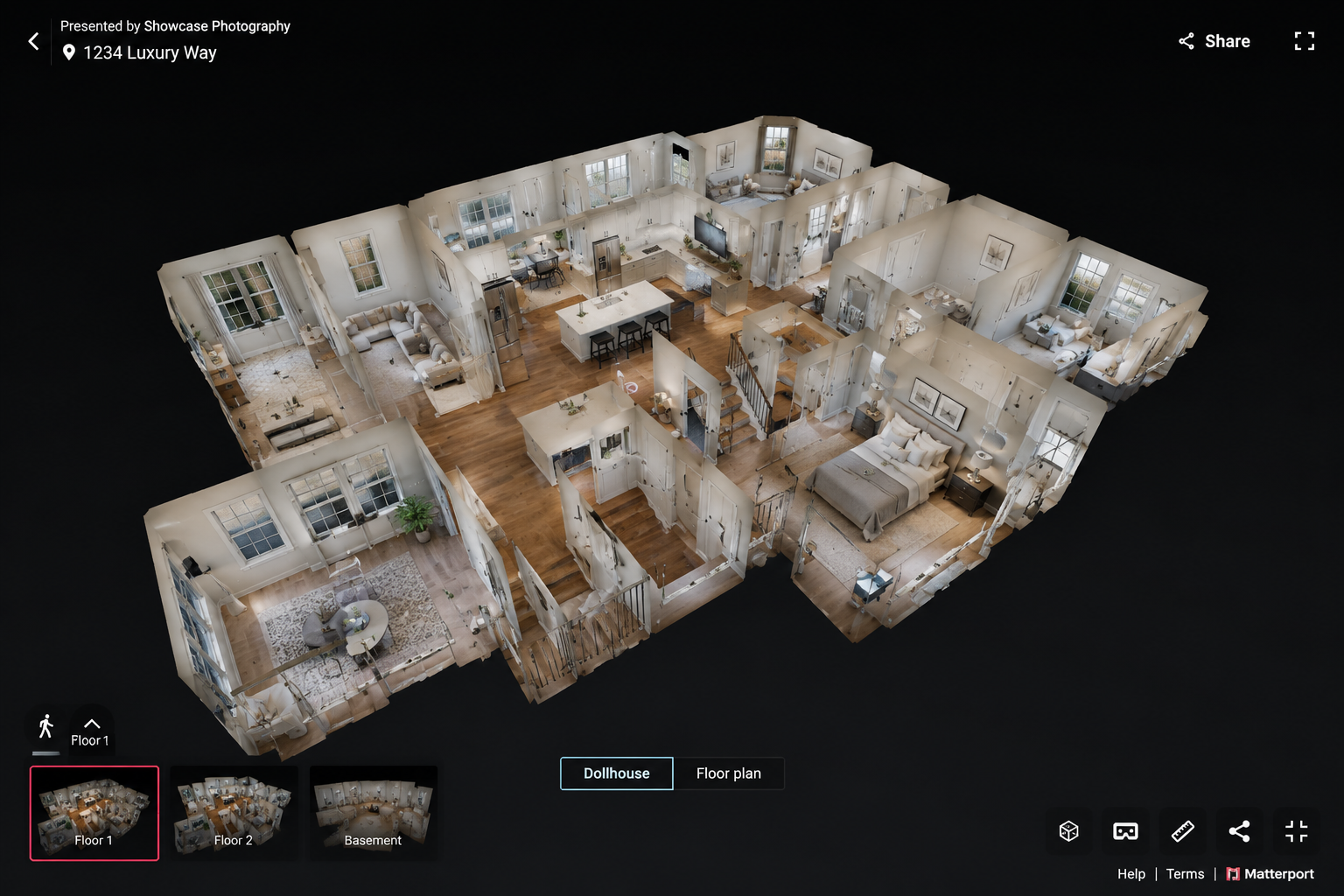
Matterport has been the default 3D capture choice for North American real estate for the better part of a decade. The question worth asking in 2026 is not whether to use Matterport or one of its competitors. The question is whether 3D capture belongs on a given listing at all, and if so, what flavor of it actually moves the decision the brokerage is trying to move.
This is the framework we walk enterprise brokerages through when they audit their 3D capture spend. The conclusions are opinionated. The underlying decision is the same across residential and commercial: buyer behavior, not asset type, determines whether 3D earns out.
What 3D actually does, in plain terms
A 3D capture, whether from Matterport, Insta360, or any of the emerging entrants, produces three artifacts: a navigable walkthrough the buyer can explore in their browser, a dollhouse view that gives a building-level sense of layout, and a set of measurement-grade dimensions extracted from the capture. Each artifact has a different audience.
- The walkthrough drives buyer time-on-page and is the part most listing platforms surface natively. It is the consumer-facing artifact.
- The dollhouse sells building flow on commercial assets and floor coherence on luxury residential. It is the broker-facing artifact in pitch decks.
- The measurements feed into tenant fit-out planning and listing accuracy. They are the operations-facing artifact.
Decisions about whether to commission 3D, what tier of capture to use, and how to distribute the output all improve when this triad is the starting point rather than a line item on the marketing spec.
Where 3D earns its cost
Three segments. The rest is mostly marketing optionality, not operational return.
Luxury residential ($1.5M and above)
Above $1.5M in most US metros, the buyer pool is no longer purely local. International buyers, relocating executives, and second-home shoppers all evaluate listings remotely before deciding whether to travel for an in-person tour. The conversion lift from a quality 3D walkthrough on a luxury listing is consistent and material across our data: dwell time roughly doubles, inquiry-to-showing conversion rises in the high single digits to low double digits, and the time-to-offer compresses by a measurable few days.
Commercial leasing (office and industrial)
Tenant reps and corporate real estate teams routinely tour three to seven buildings against a leasing deadline. A Matterport walkthrough on every shortlisted asset turns the decision from a series of physical visits into a post-Friday-tour comparison session, which is where the leasing decision is increasingly made. The 3D output is also the artifact prospects forward to their architects for early fit-out modeling, which keeps the asset in consideration instead of falling out of the shortlist.
Multifamily portfolio leasing
Stabilized multifamily assets benefit less per-listing but more in aggregate. A standardized 3D walkthrough across the unit mix lets prospects pre-screen unit types from a phone, which reduces the on-site staff time per signed lease. The return is in operations cost, not in conversion lift; the capture is amortized across the building’s lifetime, not a single listing.
Outside luxury residential, commercial leasing, and stabilized multifamily, 3D capture is mostly marketing optionality. It looks great on a listing. It rarely changes the outcome at a scale the spreadsheet can justify.
Matterport vs the alternatives in 2026
The capture-hardware gap that drove the Matterport monopoly through the late 2010s has closed. Insta360, Ricoh Theta, Kandao, and the iPhone Pro LiDAR pipeline can all produce usable 3D walkthroughs at a fraction of the dedicated-camera cost. The decision in 2026 is no longer about who has the best camera.
Three factors actually decide the choice for an enterprise brokerage. None of them is image quality.
- Workflow fit. Where the deliverable lives and how it distributes. Matterport plugs into more listing platforms natively than any competitor, and the brokerage workflows are familiar.
- Measurement accuracy. Matterport’s measurement extraction is still the most defensible for downstream uses (BOMA cross-check, tenant fit-out, asset documentation). Competitors are closer than they were two years ago but not yet equivalent.
- Hosting and longevity. The capture is an asset the brokerage will reference for years. The hosting fee, the export options, and the platform’s continuity all matter more than the capture session itself.
What actually moves listings, in order
From the conversion data we see across enterprise residential and commercial portfolios, the rough ranking of impact per marketing dollar is consistent.
On most luxury and commercial listings, the highest-impact media is a combination of professional HDR photography, twilight exterior, a short cinematic video walkthrough, a 3D capture, and a BOMA-grade or 2D floor plan. The order of spend matters: high-quality photography first, then floor-plan accuracy, then 3D, then video. Skipping any of the first three to add the next one is rarely a good trade.
How to spec 3D into the enterprise program
Three principles govern how 3D should be priced and routed across an enterprise portfolio.
- Threshold-based, not blanket. 3D is commissioned automatically above the price threshold for residential and on every shortlisted commercial asset. Below the threshold it is opt-in for the listing agent, with the published price visible at booking.
- Standardized capture spec. Resolution, dollhouse generation, branded skin, distribution endpoints all defined per service. The capture quality should not vary by which local operator was available.
- Asset library treatment. The 3D file is a first-class asset in the library, with metadata for the property, the capture date, the spec version, and the reusable measurements. It is not a vendor portal link the marketing team has to chase a year later.
AssetOSX runs this 3D spec and routing layer across the marketplace. The full service catalog is referenced on the FAQ page and the asset library treatment is part of the broader standardization blueprint we covered earlier.