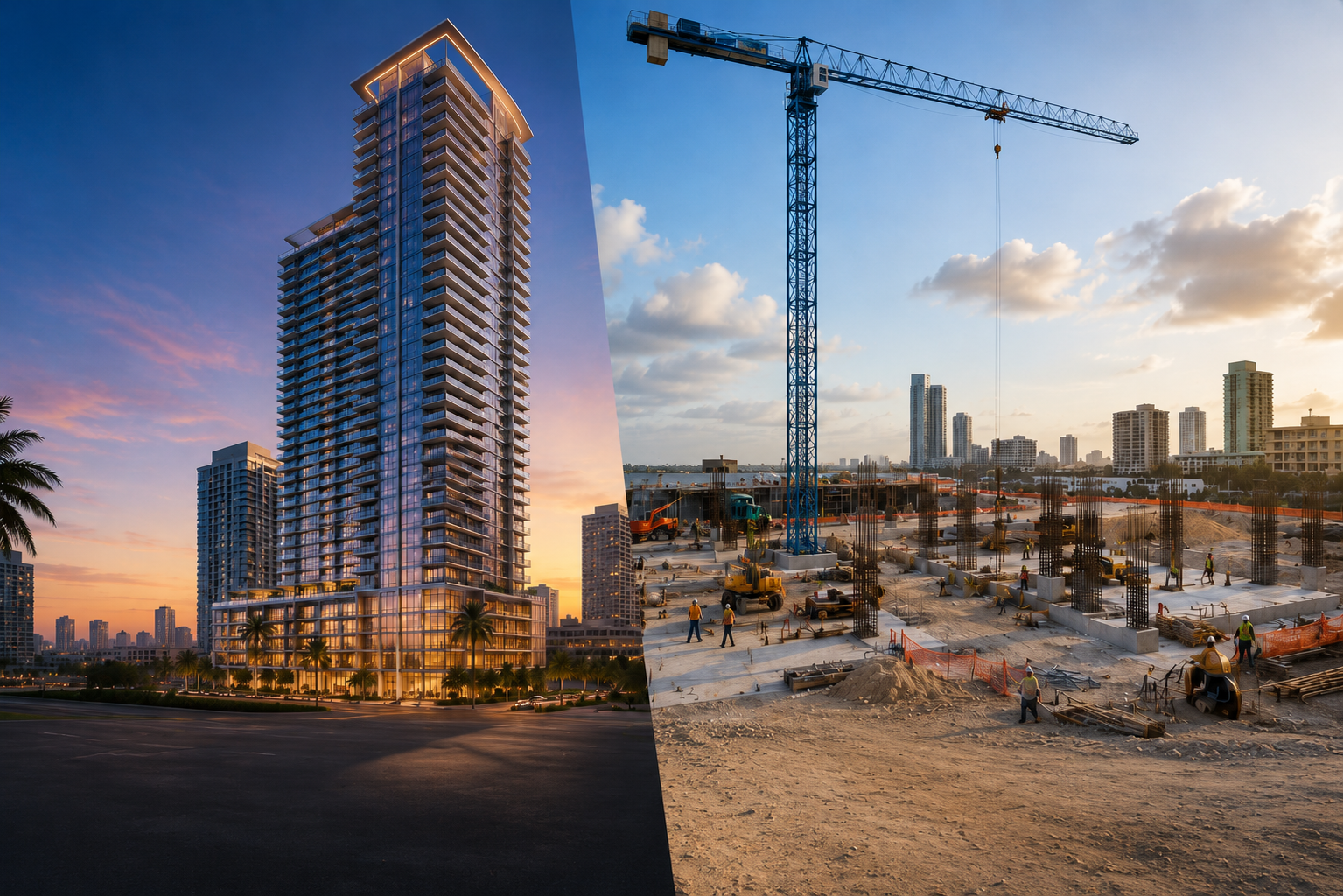
Pre-construction marketing is the hardest media program in real estate. The asset does not exist. The timeline runs two to three years from first reservation to occupancy. Buyers are committing real deposits against an artifact that is still on paper. And the marketing has to make the argument every single day until the building is actually built.
Most pre-construction programs over-spend on the wrong media at the wrong stage. The cost shows up in cancellation rates, in the sales gallery being too busy to scale, and in legal exposure when buyers eventually see units that do not match the photoreal renderings they were sold on. The fix is sequencing the media to the buyer’s actual decision path, not the developer’s aspirational timeline.
The three phases of pre-construction marketing
Each phase has different buyers, different stakes, and different media. The same package across all three is a misallocation in two directions.
Phase 1: positioning (months -24 to -12 from occupancy)
The buyer is making a positioning bet. They are buying the neighborhood, the architect’s reputation, the developer’s track record, and the building’s signature exterior look. The media that earns its cost here: stylized exterior renderings (not photoreal), neighborhood aerials of the actual site, lifestyle imagery captured at nearby comparable properties, an animated flythrough of the exterior approach. Total budget at this phase: roughly 35 to 45 percent of the full pre-construction media spend.
Phase 2: sales gallery (months -12 to -6)
Reservations convert to firm contracts. Buyers need to feel the building. The media that earns: model unit captures (built in the sales gallery before construction completes), photoreal renderings of signature interior spaces (lobby, amenities, primary suite), 3D walkthroughs of the model units, large-format prints for the gallery walls. Total budget: 40 to 50 percent of the full spend, concentrated in a four to six month window.
Phase 3: occupancy and launch (months -3 to +3)
Closings happen, residents move in, the asset becomes a real building. The capture program shifts to actual photography: completed exteriors, completed amenities, first-resident lifestyle imagery (with consent), drone aerials of the finished building. This becomes the asset library that supports renewals, refinancing, and resale for the next decade. Budget: 15 to 25 percent of the pre-construction media spend, with the understanding that this is the bridge to the operating-asset media program.
Buyers in phase 1 are buying the building’s positioning. Buyers in phase 2 are buying their unit. The media that wins phase 1 over-spends on photoreal unit renderings the buyer is not yet evaluating, and the media that wins phase 2 under-invests in the lifestyle imagery that closed the reservation. Phase the spend.
What not to render in phase 1
The most common over-investment in pre-construction is photoreal renderings of every unit type at first launch. These renderings are expensive ($8k to $25k per signature unit), they are subject to change as the building is value-engineered, and they create legal exposure when the delivered unit does not match the rendering precisely.
Three patterns that hold for phase 1 renderings.
- Stylized over photoreal. Painterly, slightly abstracted exterior and lifestyle renderings establish the brand without committing to the specific finishes that are still in design.
- Signature views, not every view. One rendering of the building’s primary exterior, one of the lobby, one of the rooftop amenity. Not the kitchen of every floor plan.
- Disclosure on every artifact. Every rendering carries an "artist’s rendering, subject to change" disclosure prominently. This is not optional in most jurisdictions, and it preempts the disputes that surface at delivery.
Library governance: versioning is non-negotiable
Architectural revisions happen. The 24 to 36 month sales cycle is long enough that finishes, layouts, and even unit configurations change between when a buyer reserves and when they close. The library has to make clear which version was canonical at every stage.
- Every artifact is version-tagged. Date of rendering, architectural revision number, source of truth (architect, marketing team, third-party renderer).
- Superseded versions are retained, not deleted.When a rendering is updated, the prior version moves to archived state, accessible for reference but not in active marketing distribution.
- Buyer-facing artifacts are tracked at closing.The renderings the buyer saw at reservation, deposit, and closing are documented in the deal file. When the delivered unit varies, the library is the audit trail.
Transition to the operating asset
The pre-construction library transitions into the operating multifamily or condo library at occupancy. The same property-keyed library structure covered in our multifamily lifecycle piece applies: assets attach to the property entity, ownership transitions do not reset the library, and the lease-up or post-closing media program builds on the foundation the pre-construction phase created.
AssetOSX runs the pre-construction media layer for developer, brokerage, and sales-gallery teams across the US and Canada. The phase-aware spec catalog and the long-cycle library governance are summarized on the enterprise FAQ.