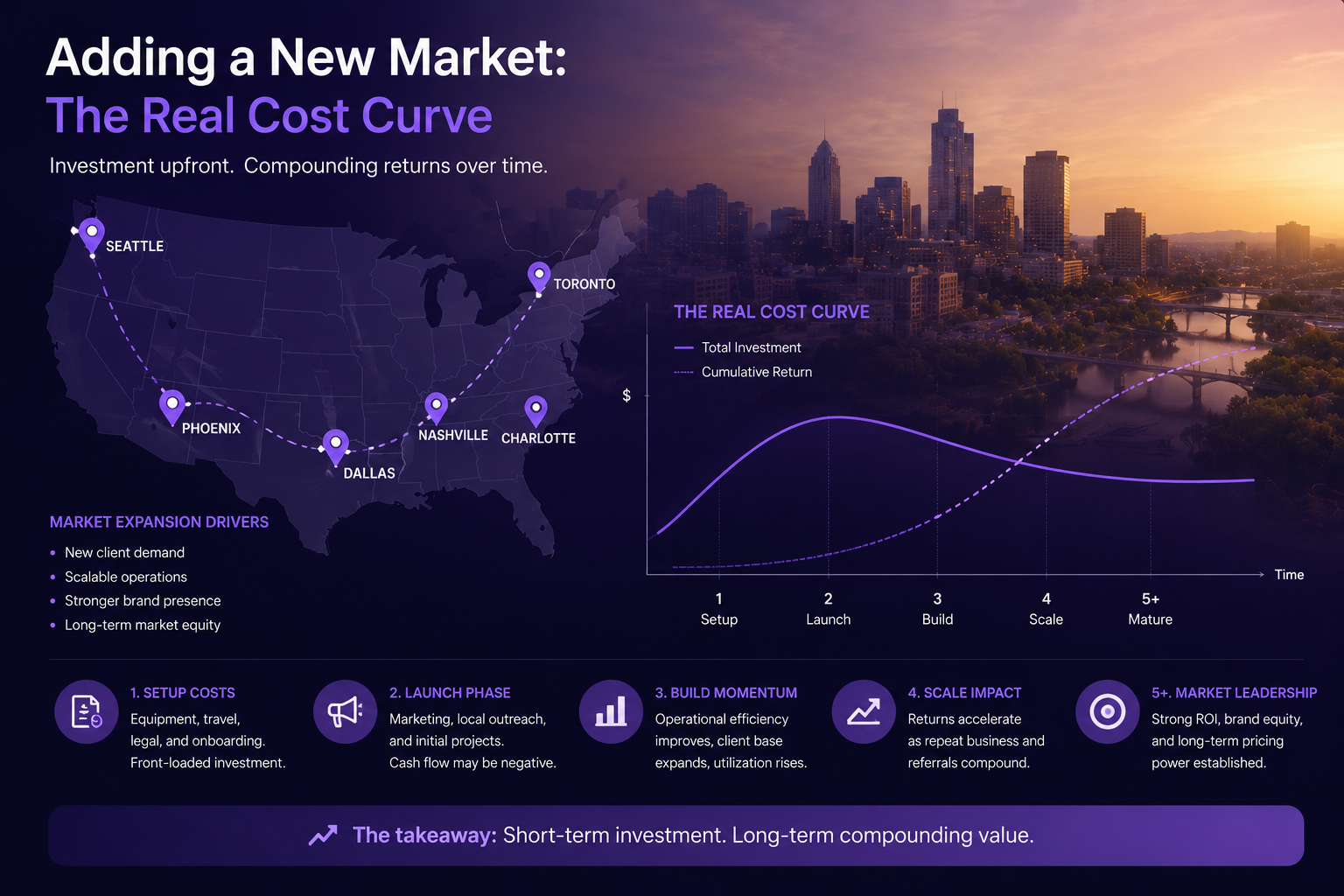
Adding a new market sounds like a unit-economics question. Spread the platform’s fixed cost over more listings, get cheaper per-shoot economics, expand the moat. In practice the math is messier. The fixed cost of standing up a new market is consistently underestimated, the operational drag on adjacent markets during the rollout is rarely accounted for, and the variable cost depends on local vendor density in ways the spreadsheet never captures.
This is the cost curve we share with operations leadership before they commit to a new-market expansion. The numbers are aggregated from dozens of enterprise rollouts in the US and Canada. They will not match any individual market exactly. They will match the average within a defensible band.
The fixed stand-up: $45k to $90k in year one
Every new market requires a stand-up cost that does not scale with listing volume. The cost lives in four buckets.
Vendor onboarding
$12k to $20k. Three to seven new vendor relationships at four to eight hours of operations time each (insurance verification, master service agreement, payment terms, calibration shoot, spec training). Add legal and finance review at two to three hours per vendor. Loaded at $85 to $180 per hour depending on the function.
Spec calibration
$6k to $12k. The local vendor pool delivers against your spec on the first ten to fifteen shoots, with QA exceptions on most of them. Operations works through the calibration exceptions, vendors revise, the spec lands. Until it lands, the marketing team is doing additional manual QA on every delivery.
Finance and AP integration
$8k to $18k. Cost-center mapping for the new market. Approval-chain configuration for the new offices. Reconciliation rules tuned for the local vendor invoice formats. Setup for the first three to four invoice cycles before the workflow stabilizes.
Asset library migration
$19k to $40k. If the market already has listings under prior vendors, the existing assets need to migrate into the library with metadata. Most of this cost is labor (mapping listing addresses to assets, applying metadata, verifying license rights). Some is the storage cost of the migrated archive.
The $45k to $90k year-one fixed cost is real and largely invisible until quarter three, when finance asks why the new-market launch ran over budget. Budget for it ahead of time, or absorb it in heroics from the operations team.
Variable cost: where local conditions actually matter
The variable cost per shoot in a new market is bounded by two local conditions: vendor density and pricing reference. Both vary more than the spreadsheet expects.
Vendor density
Major metros (top 20 US markets) have 20 to 80 viable commercial photographers per market. Secondary metros (rank 21-50) have 8 to 25. Tertiary markets (rank 51 and below) have 3 to 10. The platform’s routing algorithm has materially less to optimize against in tertiary markets, and the on-time arrival SLA tends to drift 3 to 5 percentage points lower simply because the bench is thinner.
Pricing reference
The same residential photography package clears $185 in a low-cost-of-living tertiary market and $410 in a high-cost coastal metro. Standardizing pricing across these markets means publishing two different per-market prices, both defensible against local cost of living. The brokerage cannot pay tertiary-market rates in San Francisco and cannot pay coastal-market rates in Cleveland without losing operator quality on one end or burning budget on the other.
The cross-market operational drag
The cost most missed in the new-market business case is the operational drag on the markets the brokerage already operates. During a new-market rollout, the operations team is divided. SLA compliance in the existing markets drops 2 to 5 percentage points during the launch quarter. That drop translates into late listings, missed mandates, and marginal-margin erosion on volume that was supposed to be steady-state.
The fix is sequencing, not parallelism. Enterprise rollouts we have run successfully hold to a maximum of two simultaneous new-market launches per operations team. Push beyond that, and the second-order cost on the steady-state markets exceeds the contribution of the new ones for the first two quarters.
The second time is cheaper
The good news on new-market economics: the playbook gets cheaper. The first market a brokerage adds under a standardized program absorbs the full $45k to $90k. The third market costs 30 to 50 percent less because the operations team has the muscle memory. By the fifth market, the stand-up runs $20k to $40k. The variable cost stays the same, but the fixed friction compounds downward.
- Market 1 to 2. Heaviest stand-up cost. The playbook is still being written. Allow 12 to 16 weeks to steady-state.
- Market 3 to 5. Playbook stabilizes. Cost drops 30 to 50 percent. Steady-state in 8 to 10 weeks.
- Market 6 onward. Stand-up is mostly parameterized. Cost drops 50 to 65 percent of the original. Steady-state in 6 to 8 weeks.
AssetOSX runs the new-market expansion framework for enterprise brokerages, landlords, and portfolio managers across the US and Canada. The implementation phases are on the enterprise FAQ and tied to our six-phase rollout framework.