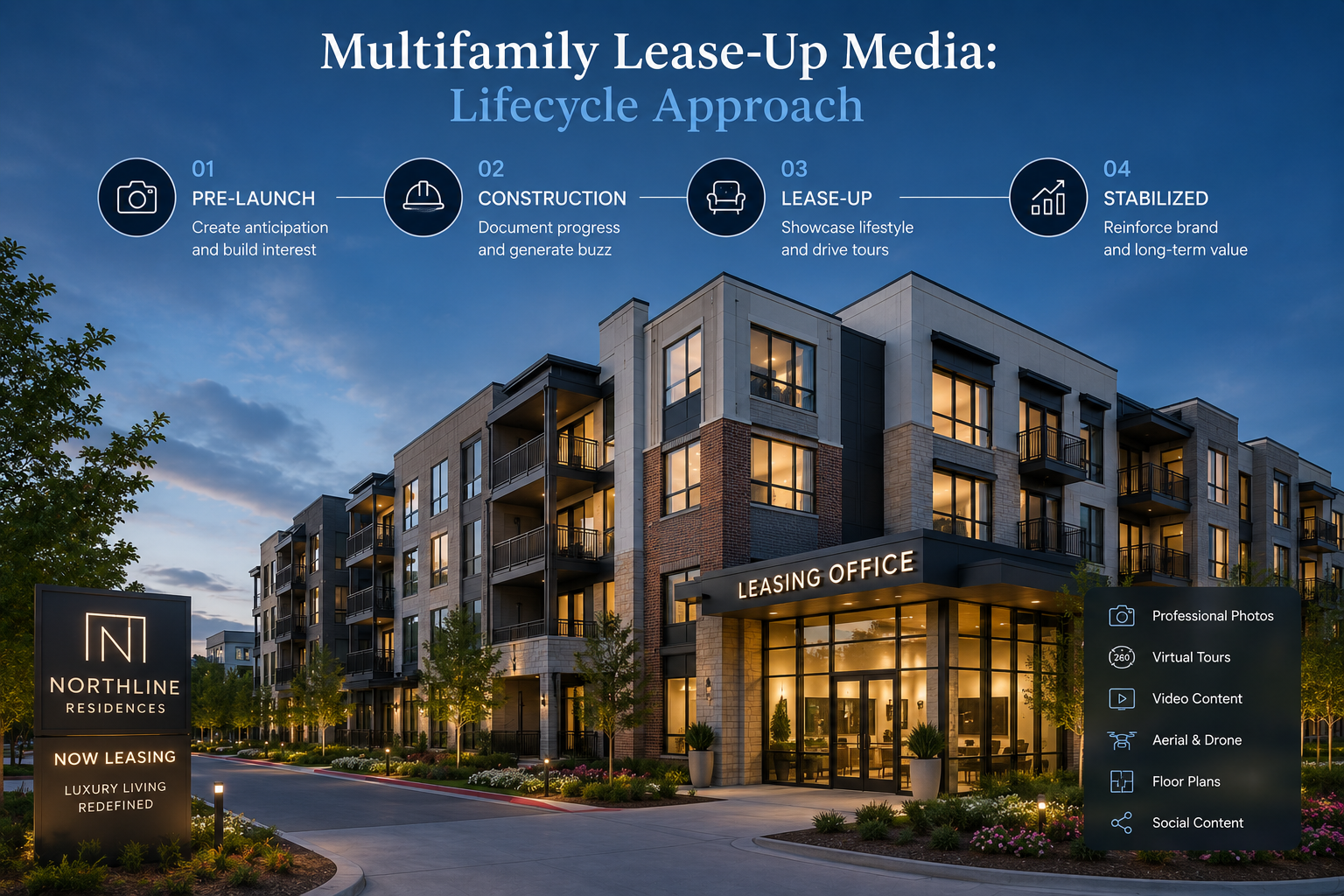
Most multifamily owners treat media like single-family residential, with one capture event at lease-up and minimal thought after. That model leaves money on the table. A well-run multifamily media program is a lifecycle asset that compounds value across lease-up, stabilization, renewals, refinancing, and eventual disposition. The cost is similar; the per-use return is multiples better.
This is the framework we walk multifamily owners and portfolio managers through during enterprise discovery. It is opinionated about two things: the capture cadence, and where the asset library lives across ownership transitions.
The four lifecycle phases of multifamily media
Each phase has different audiences, different deliverables, and different reuse expectations. A lifecycle-aware program captures for all four upfront.
Pre-stabilization lease-up
Two to four weeks before public lease-up. Model unit captures (photography, 3D tour, floor plans), amenity captures (gym, pool, lounge, co-working spaces), exterior and aerial, neighborhood context. Audience: prospective renters during the first six months of occupancy. The deliverables push to the leasing site, ILS partners (Apartments.com, Zillow Rentals, Costar), and social.
Stabilization re-capture
Six to nine months after lease-up launch. The landscape has matured, the signage is permanent, amenity programming is live, the property looks finished. Re-capture the exterior, landscape, and the amenities that are now activated. Audience: renewals, second-wave lease-ups for any unit type that did not absorb in the first wave.
Renewal and operations
Year two and beyond. Smaller, targeted refresh: seasonal amenity shots (pool in summer, lobby in winter), event- driven captures (resident events, market campaigns). The library does the heavy lifting; the marginal capture is small.
Refinancing and disposition
When the asset goes to refinance or sale, lenders and buyers need a clean media set. A lifecycle-aware library produces it in a day. A library that was abandoned after lease-up produces a panicked reshoot.
The multifamily media question is not how much to spend on lease-up. It is whether the lease-up capture is going to be usable in year three, when the asset is being refinanced. That answer is determined by the spec and the library, not the budget.
The two-capture model that pays off
The two highest-impact captures are at pre-stabilization (lease-up) and at stabilization (six to nine months in). Both should be in the original program budget, not deferred.
Pre-stabilization capture
Model units staged to the brand standard, including a unit for every floor plan offered. 3D tour for every model unit type so prospects can pre-screen from a phone. Amenities at peak presentation (pool clean, gym uncluttered, lounge styled). Exterior daytime and twilight on the right assets. Drone aerial showing neighborhood context.
Stabilization re-capture
Same exterior and amenity captures with landscape matured and signage installed. New aerial showing the finished property in its neighborhood. Resident-presence shots (where consent allows) showing the building activated. This is the set the marketing team will use for the next four years.
The library has to outlive the owner
The pattern we see repeatedly in multifamily: the lease-up team commissions the capture, the asset moves to a stabilized operations team (often with a different management company), and the operations team does not inherit the media library. Within a year, the asset is being marketed on a thinner, less-consistent set than the original. At refinance, the gap shows up as additional cost on the capital event.
The fix is to attach the library to the property-level entity, not the operating team. The same library serves the lease-up vendor, the stabilization team, the refinance broker, and eventually the disposition advisor. Ownership transitions stop resetting the asset.
- Property-keyed library. Assets live under the property entity (legal address, parcel ID). Operator memberships come and go; the library does not.
- Spec versioning. When a new operator takes over with a different brand spec, the prior assets stay accessible while the new captures bridge to the new standard. Both versions are retrievable for at least 24 months.
- License rights tracked. Multifamily assets often have ambient-resident risk; license rights (was a resident in frame, did they sign release) need to be metadata-tagged. The library is the audit trail when ownership asks.
The commercial-multifamily lift
The same lifecycle approach applies, with slight adjustments, to senior living, student housing, and mixed-use lease-up projects. The two-capture model holds. The library’s property-level keying is the same. The deliverables drift toward more 3D and floor plan accuracy for senior living (compliance and accessibility documentation) and toward more drone and neighborhood context for student housing (where parents are the buyers and they want to see the walk to campus).
AssetOSX runs this multifamily lifecycle layer for enterprise multifamily portfolios across the US and Canada. The vertical service catalog is on the enterprise FAQ and the broader asset library architecture is covered in our asset library piece.