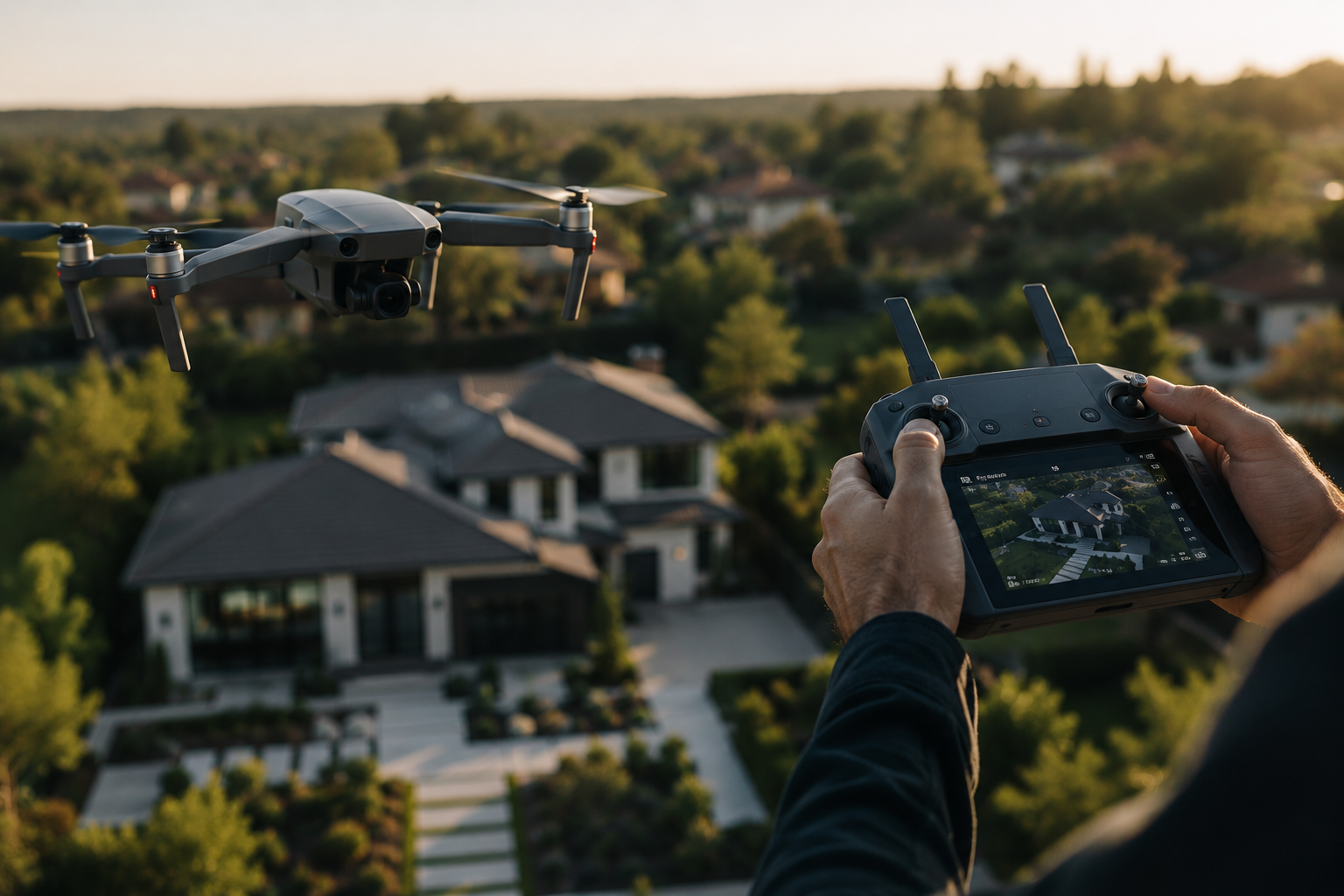
Drone capture used to be the optional upgrade on a luxury listing or a sprawling commercial asset. In 2026 it is a default on most enterprise media packages. That shift made drone vendors a regular line on the cost report, which is useful. It also made FAA compliance, insurance verification, and capture-spec enforcement a regular operational risk, which is rarely acknowledged.
This is the framework we ship as part of every enterprise rollout that includes drone capture. It covers what to verify on every operator, what insurance to require, and what the spec needs to look like so the output is consistent across markets.
FAA Part 107 is non-negotiable
Every commercial drone flight in US airspace is governed by 14 CFR Part 107. The pilot must hold a current Remote Pilot Certificate. The aircraft must be FAA-registered. Operations in controlled airspace (Class B, C, D, surface E) require LAANC authorization before takeoff. There are no enterprise carve-outs, no friend-of-the-listing-agent exceptions, and no retroactive forgiveness.
The enterprise risk is not the rare brokerage that flies without a certified pilot deliberately. The risk is the brokerage that delegates verification to local offices and ends up dispatching uncertified operators by accident, then discovering it during an insurance claim or an FAA inquiry eighteen months later. The fix is verification at vendor onboarding and again on a published renewal cycle.
What to verify, by document
- Remote Pilot Certificate. Issued by FAA, renewable every 24 months. Pull the operator’s certificate number and verify against the FAA Airmen Inquiry portal at onboarding.
- Aircraft registration. Every drone over 0.55 lbs (250g) used commercially must carry a current FAA registration sticker. Get the registration number for each aircraft the operator flies.
- Remote ID compliance. As of 2024, all drones flown under Part 107 must broadcast Remote ID (FAA equivalent of a digital license plate). Confirm the drone fleet supports it via firmware or standalone module.
- LAANC integration. The operator should file LAANC requests through an approved app (Aloft, Skyward, AirMap) for every flight in controlled airspace. Brokerages should require LAANC confirmation be attached to the delivery package on those flights.
Compliance is not paperwork. It is the difference between an insured shoot and a denied claim. Across an enterprise portfolio, the cost of one denied claim more than pays for twelve months of disciplined verification.
Insurance: the three policies that matter
Drone insurance is not a single product. It is a stack of three coverages that map to three distinct risk categories. Enterprise brokerages should require all three on every dispatched operator, with the brokerage named as additional insured on the first two.
Commercial general liability
$1M per-occurrence minimum on enterprise programs. $2M preferred for larger portfolios. CGL covers bodily injury and property damage caused by the operator’s general business activities, not just drone-specific risks. Most photographers carry it; verify the specific limits and the certificate-of-insurance status before dispatching.
Aviation liability endorsed for unmanned aircraft
This is the policy CGL alone does not cover. Standard CGL excludes aircraft-related liability. The drone-specific endorsement (or a standalone aviation policy from carriers like Global Aerospace, Skywatch, or BWI) covers third-party damage and bodily injury caused by drone operation specifically. Enterprise minimum: $1M per-occurrence with the brokerage as additional insured.
Hull (aircraft physical damage)
Covers the drone itself if damaged or lost during operation. This is the operator’s asset to insure, not the brokerage’s. But the brokerage should require that hull coverage exists, because uninsured drones get parked when damaged, and parked drones miss shoots.
The capture spec across a multi-market portfolio
A consistent drone deliverable across forty markets requires the same five-element spec on every shoot. Skip any element and the asset library inherits variance the marketing team has to manually normalize on delivery.
- Altitude range per shot. Hero exterior at 80-150 feet AGL, neighborhood context at 200-300 feet AGL, property-line orbits at 60-100 feet AGL.
- Shot list. Hero exterior (4 sides), full orbit (4 cardinal compass points), neighborhood pull-back, property-line top-down, optional sunset hero.
- Deliverable formats. RAW DNG plus color-graded JPEG for stills; 4K MP4 at 24fps for video, minimum 30 seconds per cut.
- Pre-flight verification. B4UFLY weather and TFR check, LAANC approval where required, screenshot attached to delivery package.
- No-fly enforcement. Operator must abort flights over national parks, stadiums during events, prisons, DC SFRA, and any locally posted restriction. The consequences for flying anyway sit on the brokerage as much as the operator.
Enterprise governance, three rules
Drone compliance scales when three rules are in the workflow, not the vendor agreement.
- Verify at onboarding, re-verify annually.Part 107 certificates and insurance COIs expire. The platform should block routing to operators whose documents have lapsed, with reminders 60 and 30 days before expiry.
- Require LAANC attachment on controlled-airspace shoots. Auto-flag deliveries from controlled airspace that arrive without the LAANC approval screenshot. The flag is the audit trail.
- Standardize the spec, not the operator.Local vendors stay local. The spec is the same in every market. The platform routes; the spec governs.
AssetOSX runs this drone-operations layer across the marketplace for enterprise brokerages, landlords, and portfolio managers in the US and Canada. The full vendor verification model is summarized on the enterprise FAQ and tied to the broader vendor SLA framework we covered earlier in the series.