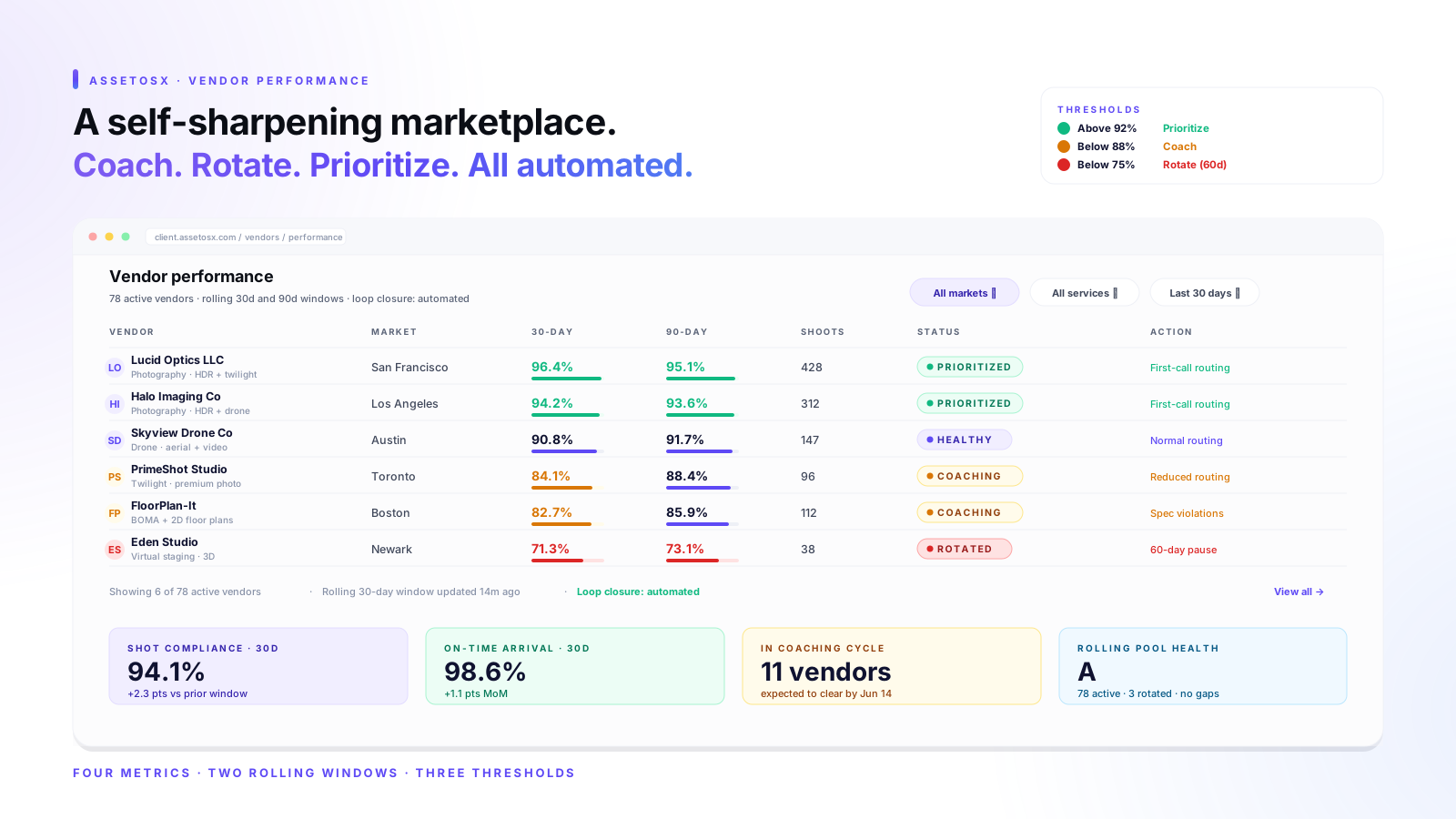
Vendor scoring is the cheapest operational lever an enterprise media program has and the most-mis-implemented. Done well, it produces a self-sharpening marketplace where underperformers rotate out automatically and top performers get more volume. Done badly, it becomes a quarterly spreadsheet exercise that procurement runs and operations ignores, while the actual routing decisions are made by whoever the office manager called first.
This is the scoring framework we install on every enterprise rollout. It is opinionated about four things: the metrics (only four), the rolling windows (two, both used), the thresholds (three actions), and the loop closure (automated, not manual).
The four metrics, each binary per shoot
We covered the underlying SLAs in the vendor SLAs piece. The score is the rolling composite of the same four binary checks: arrival, completeness, processing, upload.
On-time arrival
Operator on site within 15 minutes of the scheduled start. Pass-fail per shoot, stamped from the operator app or GPS-verified check-in. Late arrival is the leading indicator of every other failure on the shoot; capture is compressed, spec compliance drops, post-processing rushes. The metric catches the upstream cause.
Complete shot list capture
Every shot in the spec is delivered. Verified at QA against the shot-list checklist. Missing a shot is a fail, regardless of the quality of the shots that were captured.
Post-processing within spec window
Edited deliverables land within the spec window from shoot completion. The window is service-specific (24 to 48 hours on standard photography, 48 to 96 on video, 72 on floor plans). A late delivery is a fail.
Asset upload to library
Deliverables in the asset library within 60 minutes of post-processing completion, with metadata complete. Upload delays cascade into distribution delays, which is where the listing agent feels the program slipping.
Four metrics. Each binary. Each instrumented. The score is the rolling composite, and the actions that follow from it are automatic. No quarterly review meeting needed.
Two rolling windows, both used
A score on a single window is incomplete. The 30-day catches recent slippage; the 90-day smooths variance. Use both; report both; act on both for different reasons.
The 30-day window
Catches a vendor who was strong six months ago and is slipping now. The score on this window is the operator view: who is currently performing, who is currently in trouble. Coaching triggers off this window because the signal is fresh.
The 90-day window
Smooths variance. A vendor with one hard week or one difficult shoot does not get rotated out on the 90-day because the rest of the quarter compensates. Rotations trigger off this window because the signal is durable.
Three threshold-driven actions
The score is not the point. The actions that follow from it are.
Coach (below 88% on 30-day)
The vendor enters an automated coaching cycle. The platform attaches the specific spec violations from the recent failed shoots, schedules a coaching call with the regional operations lead, and continues routing at reduced volume until the cycle clears. No one chases the vendor; the platform manages the cycle.
Rotate (below 75% on 90-day)
The vendor rotates out of the local routing pool for 60 days. They still receive the failed deliveries to address. The pool fills with higher performers in the meantime. The platform monitors for return-to-threshold before re-engaging.
Prioritize (above 92% on 90-day)
The vendor gets first-call routing on incoming shoots. Volume tier discounts apply where commercially negotiated. Quarterly recognition surfaces in the procurement review. Top performers get the volume; the program does not have to manage that allocation manually.
Loop closure is automatic, not manual
Most vendor scoring programs we audit have the four metrics, the rolling windows, and the threshold framework on paper, and then run the entire action loop through a quarterly spreadsheet review that procurement does manually. The lag between the score change and the action is the program’s failure mode. By the time procurement notices the slippage, the vendor has shot another twelve listings in the slipped condition.
The fix is automation. The platform crosses the threshold, the action triggers, the vendor and the operations lead are notified. The quarterly procurement review becomes a rollup, not a discovery exercise.
- Threshold crossings auto-notify. The vendor knows the same day they cross the coaching threshold, not at the end of the quarter.
- Routing changes auto-apply. The next booking that would have gone to the coached vendor routes to the next-best operator instead. No human in the loop.
- Re-engagement is rule-based. A coached vendor returns to full routing when their 30-day score crosses back above the threshold. A rotated vendor returns when their 90-day clears at the end of the 60-day window. The rules are explicit and visible to vendors.
What this changes for vendors
The vendor experience under a scoring program done well is meritocratic and predictable. They see their score, they see the threshold lines, they see the consequences. Strong operators get more volume and better rates over time. Underperformers get coached before they get rotated, and rotated before they are removed.
Vendors do not resent scoring. They resent arbitrariness. A scored program where the rules are visible and the actions are automatic is the program vendors prefer; the ambiguous program is the one that erodes the partnership.
AssetOSX runs this scoring layer for enterprise customers across the US and Canada. The vendor network is summarized on the enterprise FAQ and the implementation framework lives on the about page.