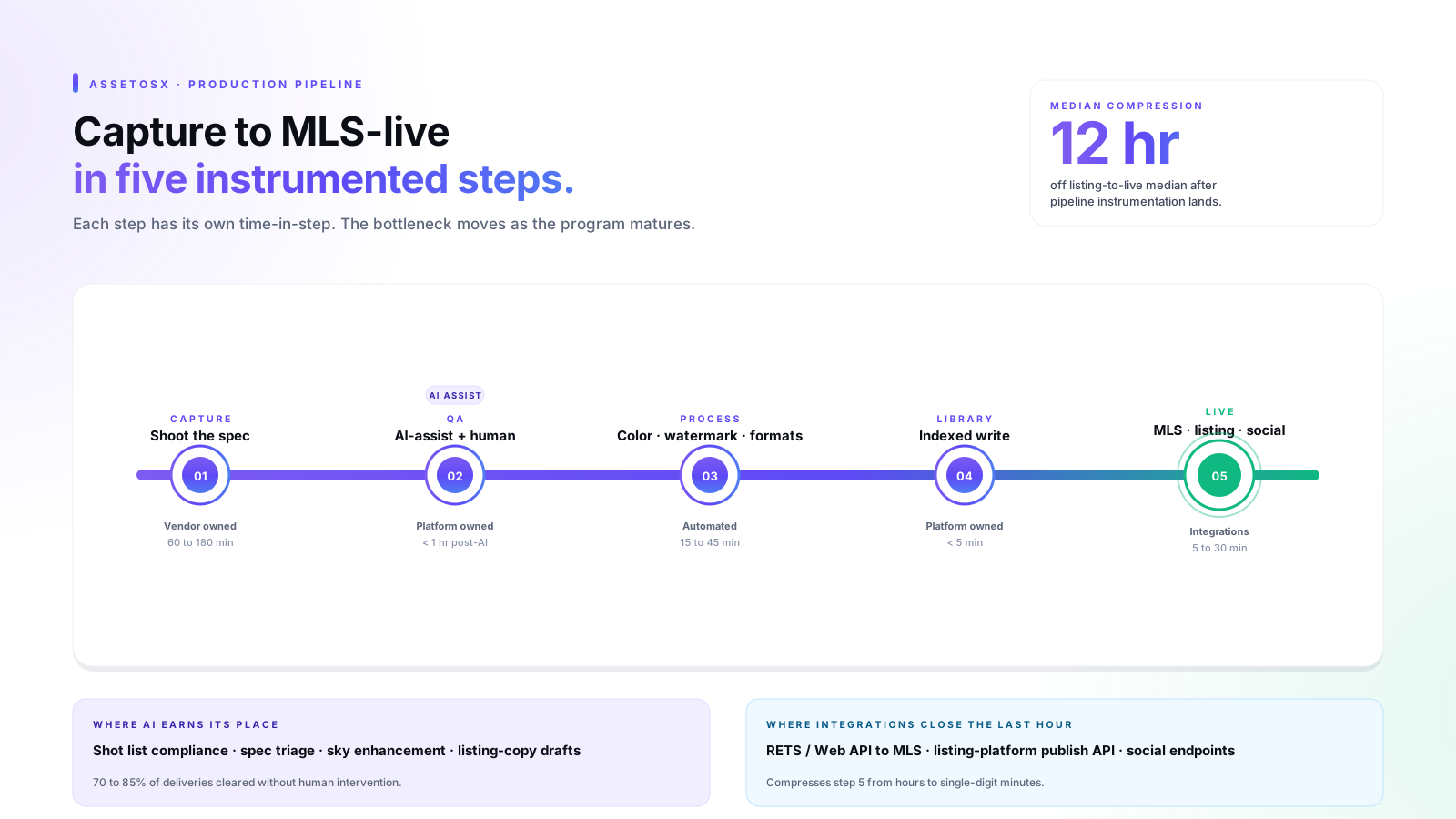
Every enterprise media program runs the same five-step production pipeline from capture to MLS-live. Most programs do not instrument it. They have one number (listing-to-live median) and no visibility into which step is consuming the hours. Compressing that median requires breaking the pipeline open and timing each step.
This is the production-pipeline framework we install on every enterprise rollout. It is not new technology; it is an instrumented view of work the program is already doing. The compression comes from making the bottleneck visible and applying the right intervention at the right step.
The five steps, in order
Step 1: capture
Operator on site, shoots the spec, completes the job. The SLA window is on-time arrival, complete shot list capture verified against the spec. Owned by the vendor. Median duration: 60 to 180 minutes per shoot, plus travel.
Step 2: in-platform QA
Delivered files arrive at the platform. Spec compliance is verified, shot list is checked against the brief, basic processing standards are evaluated. AI-assist handles the bulk of deliveries; human QA reviews the exceptions. Median duration after AI-assist: under 1 hour. Before AI-assist: 4 to 6 hours.
Step 3: automated processing
Color grading to the brand LUT, sky enhancement where applicable, watermark application where required, output format generation (web-optimized, print-ready, social cutdowns). Fully automated for compliant deliveries. Median duration: 15 to 45 minutes.
Step 4: library write
Processed deliverables write to the asset library with full metadata: listing, vendor, spec version, processing status, license rights. Indexed for retrieval. Median duration: under 5 minutes when the library is the source of truth, materially longer when shadow libraries are in play.
Step 5: distribution push
Direct push to the MLS, the brokerage’s listing platform, syndication partners, and any social cutdown endpoints. Owned by the platform’s integration depth. Median duration: 5 to 30 minutes when integrations are wired, hours when handoffs are manual.
Listing-to-live is not one number to optimize. It is a pipeline of five steps, each with its own bottleneck profile and its own intervention. The compression program improves the right step, in the right order, not the loudest step.
Where the hours actually go
Across the programs we have instrumented, the time distribution is consistent. Median listing-to-live of 36 business hours breaks down roughly:
- Capture (booking-to-shoot-completion): 8 to 24 business hours. Dominated by operator availability and seller readiness. Compressed by routing improvements and self-serve booking.
- In-platform QA: 4 to 6 hours pre-AI, 0.5 to 1 hour post-AI. The highest-leverage intervention is AI-assisted QA on the clean deliveries.
- Automated processing: 0.25 to 0.75 hours. Already fast on most enterprise programs.
- Library write: 0.08 to 0.5 hours when the library is sanctioned. Hours when shadow libraries fork the flow.
- Distribution push: 0.08 to 0.5 hours with integrations. 2 to 4 hours with manual handoffs.
AI-assist: where it actually pays off in the pipeline
We covered the broader AI question in our earlier piece on AI in real estate media. The pipeline application is narrower and more defensible.
- Shot list completeness. Vision models can verify that the required shots are present at QA arrival. Missing shots are flagged before they reach marketing. Median time-saved: 2 to 4 hours per exception case.
- Spec compliance triage. Color grading, exposure, framing, post-processing standards can be scored against the brand LUT and the spec. Compliant deliveries clear automatically; exceptions route to human QA with the specific violations attached.
- Sky and lawn enhancement. Already deterministic enough to run automatically on every shoot, labeled in the asset library metadata.
- Listing description drafting. Operator review still required, but the first draft compresses 60 to 80 percent of the copy time.
Integration depth closes the last hour
After AI-assist compresses QA, the pipeline’s bottleneck moves to distribution. Programs that push to the MLS via RETS or Web API, to the listing platform via its publishing API, and to social via scheduled endpoints compress the last step from hours to minutes. Programs that rely on email handoffs and manual uploads cap out: the compression elsewhere does not help if the listing waits three hours for a human to upload to the MLS.
The integration backlog is usually the lowest-glamour operations investment and the highest-impact. Three to four engineering weeks across the major integration endpoints closes the gap most programs leave open after every other step has been tuned.
How to instrument your pipeline
Three practical steps that produce a defensible pipeline view inside a quarter.
- Stamp every transition. Booking-created, shoot-started, shoot-completed, delivery-arrived, qa-approved, library-written, distribution-pushed. Each transition is a structured event with a timestamp.
- Report time-in-step. Daily and rolling-30-day. Surface the step with the longest median and the highest variance. That is the right next intervention.
- Tie interventions to step. Self-serve booking compresses step 1. AI-assist compresses step 2. Integration depth compresses step 5. Don’t cross-attribute or the program loses the story finance needs to fund the next investment.
AssetOSX runs the instrumented pipeline as a first-class layer for enterprise customers. The pipeline data feeds the listing-to-live benchmarks covered in our benchmarking piece and the implementation framework lives on the about page.